How AIRsteril compares in the crowded air purification market
As more businesses seek solutions for managing indoor air quality and odour control, the market for air purification systems has expanded rapidly. Popular brands such as Philips, Dyson, Shark, Aeramax, MedicAir, VirusKiller, and others offer a range of products aimed at the commercial and healthcare sectors. Most of these competitor systems rely on combined filter-based approaches, typically HEPA and activated carbon, with some incorporating UV-C or photocatalytic features.
While filter systems are widely used and well understood, they also come with limitations, especially when applied to commercial or high-use environments. As this guide explores, choosing the right system depends not only on air particle capture but also on how well a product manages odours, microbial contamination, and real-world usability.
Filter systems: strengths and limits
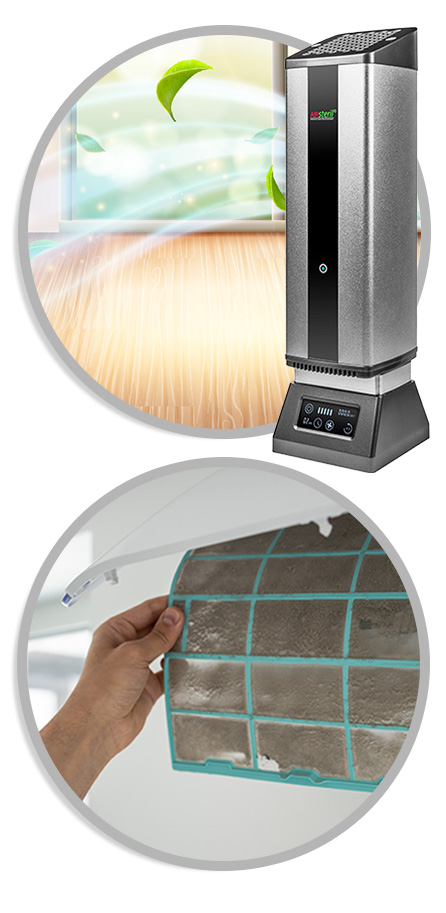
Most mainstream air purifiers, including those from Philips, Dyson, and Shark, focus on particulate capture. HEPA filters, for example, are highly effective at removing dust, pollen, mould spores, and other airborne particles. However, filters cannot destroy microorganisms or volatile organic compounds (VOCs), and many struggle to address persistent odours. Over time, filters become saturated, requiring regular maintenance and replacement, often at additional cost.
In washrooms, healthcare settings, and other odour-heavy environments, filter-based systems often struggle to deliver long-term freshness or effective microbial control. This is because these systems rely on air passing through the unit itself. In real-world settings, particularly in busy washrooms with constantly changing airflow due to doors opening, extractors running, and frequent movement, only a portion of the contaminated air will ever reach the unit. As a result, odours persist, and airborne bacteria and viruses remain in circulation. Additionally, filters do not break down microorganisms or volatile compounds; they merely trap them until the filter is replaced, which can lead to saturation and re-release over time.
How AIRsteril stands apart
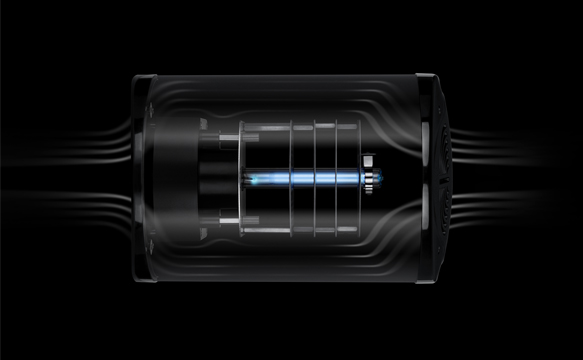
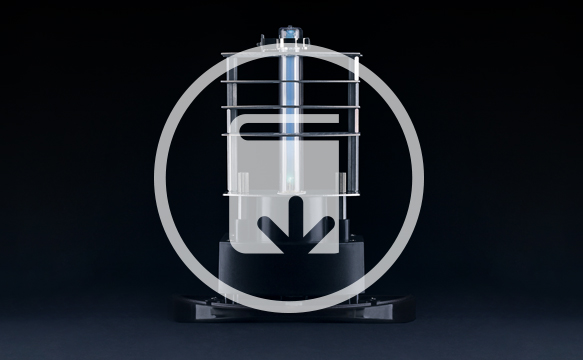
AIRsteril technology operates differently. Rather than relying on contaminated air passing through the unit, AIRsteril uses a combination of ultraviolet light and catalyst-based technologies to actively break down or remove microorganisms, VOCs, and odour-causing compounds. Through ionisation, contaminants are stripped from the air without the need for them to enter the device. The treated air becomes denser and naturally disperses away from the unit, removing the risk of reprocessing the same air or forming the ‘clean air bubble’ effect seen with some filter-based systems. This creates a more even and consistent improvement in air quality throughout the space.
This approach brings several clear advantages:
• Proven performance
Independent testing confirms AIRsteril’s effectiveness in reducing viruses, bacteria, mould, and VOCs. Results include over 99.99% airborne virus reduction in 10 minutes and a 79% drop in mould levels in washrooms.
• Odour control as standard
AIRsteril neutralises odours at their source, addressing common complaints in washrooms, offices, healthcare sites, and more. Unlike filters, AIRsteril technology does not just mask smells, it breaks them down.
• Diverse range of solutions
AIRsteril offers multiple product formats tailored to specific environments, including silent models, IP-rated units for wet areas, and 12V or 24V options for vehicles. With units suited to any enclosed space, from small offices to large industrial areas, AIRsteril supports a wide range of applications.
• Established reliability
With over 15 years of continuous use across the UK and beyond, AIRsteril has consistently refined its technology and expanded its product range to meet evolving customer needs. Unlike many recent market entrants, AIRsteril offers proven, field-tested solutions backed by long-term performance and development.
• Long-term affordability and low maintenance
Many filter-based air purifiers involve not only a significant initial investment but also recurring expenses for replacement filters. These filters often need to be changed every six to twelve months, depending on usage and environment. Over time, these costs add up, both in materials and maintenance time. AIRsteril units, by contrast, require only a simple annual UV lamp replacement and contain no filters to clog, replace, or manage. This makes them a more predictable, low-maintenance option for long-term use, particularly appealing in rental or multi-site applications.
Choosing the right system for your needs
Search data shows growing interest in terms such as “commercial odour control system”, “best commercial odour control system”, and “commercial odour control system cost”. While filter-based products can handle basic particulate reduction, businesses that prioritise odour management, infection risk reduction, and minimal upkeep should consider solutions that actively treat the air—like AIRsteril.
To find out more about how AIRsteril compares and to see the full product range, visit www.airsteril.co.uk.
The information in this article is based on publicly available sources and believed to be accurate at the time of writing. Airscience Technology International Limited makes no guarantee regarding the completeness or accuracy of third-party product details. All brand names are trademarks of their respective owners.