HEPA filters and particulate capture: what they do (and don’t) do
HEPA filters (High Efficiency Particulate Air) are one of the most recognised technologies in air purification. Used in both domestic and commercial systems, they are often marketed as the gold standard for air quality. But while they are effective in certain applications, it's important to understand what they can and cannot do.
How do HEPA filters work?
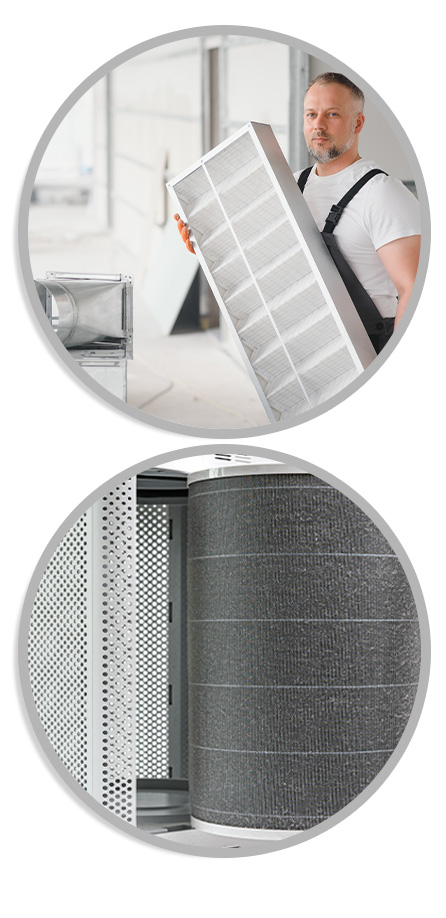
HEPA filters are dense mats of fibres designed to capture airborne particles. To meet HEPA standards (e.g. EN 1822 in Europe), the filter must remove at least 99.95% of particles at 0.3 microns in size—the most penetrating particle size.
They are particularly effective at trapping:
• Dust and pollen
• Mould spores
• Pet dander
• Certain bacteria
What HEPA filters can’t do
Despite their high filtration performance, HEPA systems have important limitations:
1. No active odour control
HEPA filters are ineffective against gases, odours, and volatile organic compounds (VOCs), as these are much smaller than the particles they are designed to capture. Odours from waste, washrooms, or chemicals remain largely unaffected unless additional carbon filters are included—and even then, performance depends on airflow and saturation levels.
2. No effect on viruses in open air
While viruses can be captured if they pass through the filter while attached to droplets or aerosols, HEPA filters don’t actively neutralise them. Viruses in the wider airspace remain unaffected unless drawn into the unit.
3. Airflow dependent
All HEPA-based systems rely on air being physically drawn through the unit. If contaminated air doesn’t pass through the filter, it remains in the room. This results in:
• Uneven performance, with treated zones (or “clean bubbles”) around the unit and untreated zones further away
• Limited reach in busy environments with shifting airflow
• No residual effect, meaning air is only treated while passing through the unit
4. Performance decreases over time
HEPA filters reduce in effectiveness as they become clogged with particles. This can lead to:
• Reduced airflow
• Lower filtration performance
• Potential for microbial growth within the filter
Filters must be replaced regularly.
5. High running and replacement costs
Many HEPA-based systems require multiple filters, including pre-filters and activated carbon layers. These must be changed every 6 to 12 months depending on use, creating ongoing costs. In commercial use, filter replacement and maintenance can exceed the original cost of the unit over time.
Systems often use complex layered filtration to compensate for each filter’s limitations. While this may improve performance, it also increases:
• Consumable costs
• Labour requirements
• Downtime for servicing
When HEPA makes sense
HEPA filtration is a strong option in settings where:
• Dust and allergens are the primary concern
• High-quality air handling systems already exist
• Occupants are sensitive to airborne particles
• Replacement filter costs are not a concern
However, in areas requiring odour control, microbial risk reduction, or continuous hygiene in high-traffic spaces (like washrooms or refuse areas), HEPA will not deliver a complete solution.