Far-UVC and emerging technologies – promising, but are they ready?
The air purification industry has seen a surge of innovation in recent years, particularly with interest in Far-UVC light (222 nm) and other emerging technologies marketed as safe for continuous use in occupied spaces. These systems aim to offer effective microbial control without the restrictions associated with conventional UV or chemical disinfection.
While early studies are promising, it is important to understand what is proven, what is theoretical, and what challenges remain before widespread adoption.
What is Far-UVC?
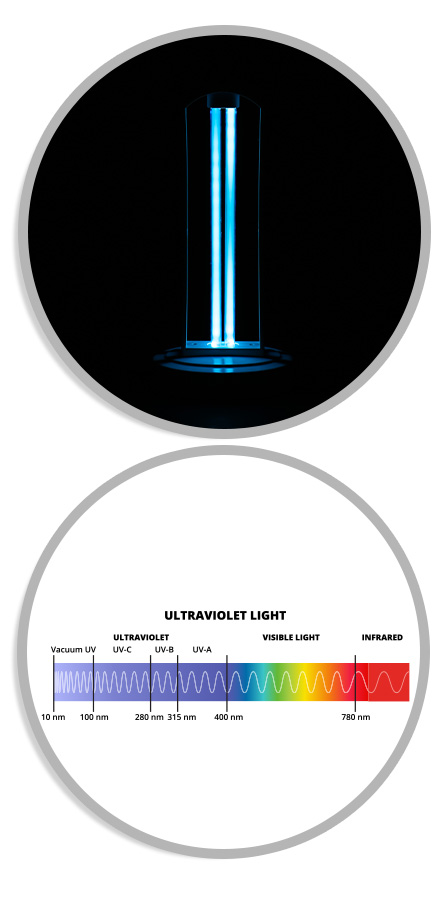
Far-UVC refers to a narrow band of ultraviolet light around 222 nanometres, typically produced using filtered excimer lamps. Unlike conventional 254 nm UV-C, Far-UVC is claimed to:
• Inactivate bacteria and viruses effectively in air and on surfaces
• Pose less risk to human skin or eyes due to its limited penetration depth
These properties have made it an attractive concept for real-time disinfection in:
• Public spaces
• Offices and retail settings
• Transport hubs
• Healthcare waiting areas
What makes it different?
Traditional UV-C must be enclosed or shielded to prevent exposure to people. Far-UVC, in contrast, is marketed as safe for direct exposure, with studies suggesting it does not penetrate living cells in the same way.
Manufacturers promote it for:
• Continuous disinfection in real time
• Use over open areas (e.g. overhead lighting)
• Minimal maintenance compared to fogging or chemical sprays
Limitations and unknowns
1. Safety data is still developing
Although early research supports the idea that Far-UVC is safer than traditional UV, long-term human exposure studies are ongoing. Regulatory bodies are cautious, and many installations still use motion sensors or interlocks to limit use.
2. Performance in real-world conditions
Laboratory conditions may not reflect dynamic environments. Factors such as:
• Distance from the source
• Airflow patterns
• Surface shadowing
...all affect actual performance.
Many Far-UVC installations are fixed-position units, making it difficult to guarantee comprehensive treatment across an entire space.
3. Limited proven coverage
Unlike enclosed UV systems that process a known air volume, Far-UVC relies on light reaching the target area. In large or obstructed spaces, significant untreated zones may remain.
4. Regulatory status varies
There is currently no universal standard governing Far-UVC safety and efficacy. Approvals differ by country, and in some regions, use in occupied spaces is still restricted or under review.
5. Cost and infrastructure requirements
Excimer lamps are expensive and have a limited lifespan. Units also require careful installation to ensure beam alignment and coverage. Retrofitting can be difficult in spaces with low ceilings or complex layouts.
Other emerging technologies
In addition to Far-UVC, a range of newer or hybrid approaches have appeared, including:
• Cold plasma systems
• Electrochemical oxidation units
• Advanced PCO variants
While many of these technologies have potential, few offer the level of independent test data or regulatory clarity that more established methods provide.
Should businesses adopt now?
Far-UVC is an exciting development with clear potential, particularly for air disinfection in high-risk public spaces. However:
• Long-term safety and effectiveness data is still maturing
• Cost and implementation complexity remain barriers
• Businesses requiring proven, compliant hygiene tools may prefer technologies with a longer track record